- This topic has 31 voices and 178 replies.
-
AuthorPosts
-
August 1, 2005 at 3:03 am #30886

Two basic types of wampum were identified at the Fredricks site: (1) a cylindrical form, which has frequently been described in the literature (bottom rows, illustrated specimens); and (2) a morphological variant on the former type which will be called oval wampum (top row illustrated specimens). The oval wampum were made by grinding the sharp corners from the ends of the cylinders. Both purple and white varieties of both types have been identified, although only five purple oval wampum have been recovered so far from this site. Overall, the wampum range in length from 4.8-7.0 mm and in diameter from 3.2-4.6 mm, with the white wampum making up a higher proportion of the smaller sizes. All of the white oval wampum were made from smaller white wampum, and they occurred exclusively with this small white cylindrical form. All the purple wampum, including the oval form, were larger than the white oval wampum.
The majority of the wampum (68%) was found with Burial 1, occurring around the neck, chest, and the lower arms areas where they were arranged in closely spaced parallel rows. The wampum with Burial 2 were found around the neck and chest in a similar pattern. The wampum with Burial 1 appeared to have been strung around the neck. The rest of the wampum were found with Burial 5. These latter specimens, probably decoration on a small bag or pouch, were lying over a cluster of two ceramic pipes, a knife, and a bird claw. The contextual relationship of the wampum at this site suggest they were used as ornaments sewn onto garments and other personal gear, and were strung as necklaces worn around the neck.
August 1, 2005 at 3:03 am #30887
In 1722, Robert Beverley of Virginia described this type of bead as being made “of the Conch Shell, as the Peak is, only the Shape is flat and like a Cheese, and drill’d Edgeways” (Beverley 1947:145). The 21 runtees from the Fredricks site ranged from 12.8-17.2 mm in length, 12.8-17.5 mm in diameter, and 4.1-6.4 mm in thickness. They were found exclusively around the neck and chest areas of Burial 1 (see runtees) and Burial 2 (see runtees). Those with Burial 2 occurred with spherical and barrel/cylinder beads. In both instances, they occurred in association with wampum. No other runtees are known to have been found at Piedmont archaeological sites.
August 1, 2005 at 3:03 am #30888
Segment beads were made from the columella of large univalves by cutting or by a groove-and-snap technique. The resulting beads were then smoothed, drilled, and strung. Their overall shape maintains the basic form of the columella although they vary in size and length; hence they range from almost a tubular shape to a disk shape. As segments of quite different forms were worn together with no indication of shape distinction, they were lumped under the single class of “segment,” with only a size distinction of small, medium, and large noted.
The preform nature of this basic bead type allowed these segments to be modified into more finished forms of beads, some of which were found at the Fredricks site. Two beads made from segments having a more finished, symmetrical form and leaning toward the discoidal end of this bead form’s spectrum were associated with Burial 5. These beads were found above the left temporal bone, next to the left ear, and are believed to have been a form of ear ornament.
August 1, 2005 at 3:03 am #30889Spherical Columella Beads Spherical beads from the Fredricks site occurred with barrel/cylinders, runtees, and wampum around the neck and chest area of Burial 2. All of these spherical beads were very badly preserved. It appeared from the few intact surfaces that they were of a more finished quality (i.e., smoother and more polished) than those from the earlier Wall site. Measurements ranged from 4.6-7.2 mm in length and from 5.4-7.3 mm in diameter.
August 1, 2005 at 3:03 am #30890
Like the other beads discussed so far, barrel/cylinder beads were made from the columella. They vary from segments in that they are characteristically longer than wide, and they have been ground along their long axis so that they are more symmetrical than the segments. Fifty-four barrel/cylinder beads were recovered from around the chest and neck of Burial 2 at the Fredricks site. They range in length from 12.2-15.4 mm, in diameter from 5.0-8.5 mm, and in thickness from 4.9-7.5 mm. All are badly damaged.
August 1, 2005 at 3:03 am #30891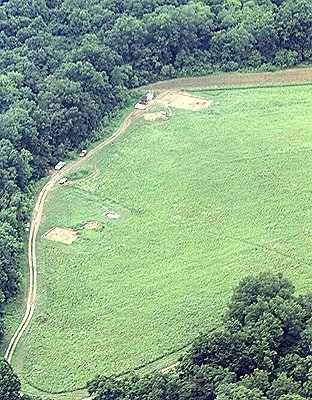
Occaneechi town dig site.
 August 1, 2005 at 3:03 am #30892

 August 1, 2005 at 3:03 am #30893
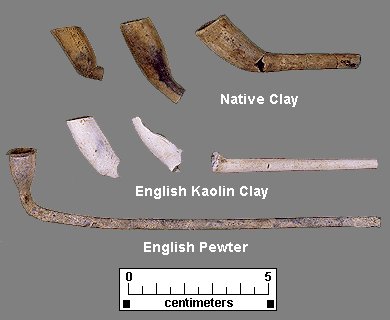
If anyoen can read the language on this one site…..you will find interesting things.
http://www.pfeife-tabak.de/Artikel/Pfeifenkunde/Indianer6/indianer6.htm
August 1, 2005 at 3:03 am #30894Now as I pointed out in a earlier post in another thread…
This is the Lakota Stone medicine wheel.


I’m not sure if anyone knows the Medicine wheel teachings…but it is our way of life…..In a way you can say the medicine wheel is almost like our bible.
August 1, 2005 at 3:03 am #30895wow..there is alot to read in this thread…I’m reading a little bit at a time lol
The design on the pendant withthe triangles……them designs have been found before….but the way they have been found is weird….because the triangle by itself has been used to mean a tee pee….however we do not use a tee pee…..so then I would say it goes to the next triangle that has been used….which represents the thunderbird….or well thunderbird tracks….however this is weird also since the thunder bird track is 2 triangles…..one on top of the other…..however the thunder bird is a Lakota thing as well and legend says a thunderbird once lived in the black hills….hopfully I got the location right on where the thunder bird lived….
so we already know the pendant found next to this is a exact copy of the Lakota’s stone medicine wheel…..so how would the thunder bird fit in…..lakota has both medicine wheel and thunder bird…also has the siouan language….so we got 3 things going for us…..and i think this next thing may be able to place the triangles into the thunderbird tracks….just withought the double triangle…..
Ok Here is Ga there is one hell of a large thunder bird…made with stones..just like how the lakota medicine wheel was created….same type of stones.
my next post I will include a photo of this HUGE thunder bird….Ga is not NC…but it shows the thunder bird was well known on the east coast as well.
August 1, 2005 at 3:03 am #30896Rock Eagle Effigy Mound
Putnam County, GA
A bird effigy mound, 102 feet long and 120 feet wide from wing tip to wing tip. A tower for viewing. The effigy mound if located 9 miles north of Eatonton at the Rock Eagle 4-H Center on US Highway 441/129. Rock Eagle Effigy Mound photo
The Rock Eagle Effigy Mound was entered on the National Register of Historic Places on 1978 23 May.
 Eagle or Thunderbird?? They cal this a Eagle….but looks like a Thunderbird to me.August 1, 2005 at 3:03 am #30897
Now right near that….is another one of these…they call the next one a Hawk.
PUTNAM COUNTY IS IN PROCESS OF DEVELOPING THE AREA AROUND THE ROCK HAWK EFFIGY NEAR WALLACE DAM
 This is a representation of the trails being developed around an early Indian Effigy known as Rock Hawk.
 The Rock Hawk Effigy is similar to the well established Rock Eagle mound at the 4H Center on Route 441 between I-20 and Eatonton Georgia.
Rock Hawk is still under development as a tourist site. The project is being carried out as a Route 16 Scenic Byway project and involves a number of organizations, among which are UGA and Georgia Power. By late 2006 the area will become a 700 acre outdoor museum with the 5000 year old Effigy (date speculative), 18th century remains, plus 15 miles of trails, an interpretive center and a viewing platform for the Hawk.
In order to see Rock Hawk and the surrounding area, take Georgia State Highway 16
 East from Eatonton towards Sparta. Take a left at the Wallace Dam Road, where you will take another left turn at the sign for the Lawrence Shoals Recreation area. .Part way along this road you will see signs for the Rock Hawk trails, and off to your left (past the old cemetery) you will see the beginnings of the parking area for Rock Hawk. Turn into this parking area and continue along the gravel road to see the Hawk effigy, surrounded by a chain link fence.
 What does the Hawk look like? Well right now it looks like a pile of rocks! When the viewing platform is built, it will transform into the shape of a Hawk, 120 ft long by 130 ft wide Both the Hawk and the Eagle mounds are believed to be have been used in some kind of ceremonial manner by the Indian tribes who inhabited the Oconee river area many thousands of years ago. Artifacts from these early tribes have been traced back as far as 10,000 years ago! It is speculated that at least 250 archeological sites are now under water since the Wallace Dam was built and the area flooded in 1979.
  Also in this area are some later historic sites. There is the remains of an old homestead and a wonderful 19th century walled cemetery that contains the family gravestones of Kinchen Little. Mr. Little was an early owner of most of the land where the Wallace Dam is now. He was one of the original families involved with the building of Rockville School, which is listed on the National Register of Historic Places.August 1, 2005 at 3:03 am #30898
http://www.geocities.com/ctesibos/symbols/native-american.html
On that web site you will find various Native american symbols and their meanings….it shows the Thunderbird tracks as 2 triangles….one on top of the other….supposed to mean good prospects.
you will also see the symbol for the 4 ages…which does kinda resemble this…however there is 6 instead of 4.

Now this is interesting also….this is pottery from Lousianna’s Ancients of man. Notice pots 2 and 4
 August 1, 2005 at 3:03 am #30899
Now if the triangles was facing the other direction…it would be the sun symbol…Life giver. Warmth, growth, and all that is good & well.

Now this is one of many types of sun symbols….whats interesting is it is using the 4 directional medicine wheel…….some wheels are the 4 directions..some have 7 directions (the 7 directions you will only see 6 directions because the 7th direction in the center of the wheel usually seen as a small circle…the 7th direction is inside you). As seen from the other pendant…you can see our ancestors was using the 7 directions on the one pendant.

This is one of the most common symbols among all Native American Indian tribes. You will note this particular sun design has seven rays. Each ray represents the seven energy centers within human beings, and also the development of each of these energy centers. This symbol identifies the healing arts, and represents a peace loving
Some Native American sun symbols have used triangles on the outside edges…however they face outward not inward.
August 1, 2005 at 3:03 am #30900Native American traditions


Native American basketball team in 1909.
The swastika shape was used by some Native Americans. It has been found in excavations of Mississippian-era sites in the Ohio valley. It was widely used by many southwestern tribes, most notably the Navajo. Among various tribes, the swastika carried different meanings. To the Hopi it represented the wandering Hopi clan; to the Navajo it was one symbol for a whirling winds (tsil no’oli’), a sacred image representing a legend that was used in healing rituals (after learning of the Nazi mimic “whirling winds” the Navajo rejected the symbol).[23] A brightly colored First Nations saddle featuring swastika designs is on display at the Royal Saskatchewan Museum in Canada.[24]
A swastika shape is an ancient symbol in the culture of the Kuna people of Kuna Yala, Panama. In Kuna tradition, it symbolizes the octopus that created the world; its tentacles, pointing to the four cardinal points, gave rise to the rainbow, the sun, the moon and the stars.[25]
In February, 1925, the Kuna revolted against Panamanian suppression of their culture, and were granted autonomy in 1930; the flag they adopted at this time is based on the swastika shape, and remains the official flag of Kuna Yala. A number of variations on the flag have been used over the years: red top and bottom bands instead of orange were previously used, and in 1942 a ring (representing the traditional Kuna nose-ring) was added to the center of the flag to distance it from the symbol of the Nazi party.[26]
-
AuthorPosts


- You must be logged in to reply to this topic.
