- This topic has 3 voices and 16 replies.
-
AuthorPosts
-
May 21, 2015 at 4:29 am #4343
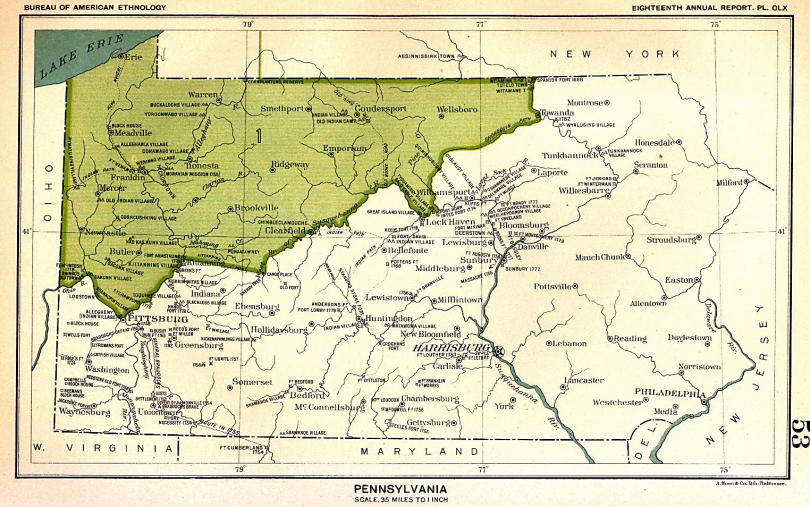 – http://usgwarchives.net/maps/cessions/ilcmap53.htm
My research keeps bringing me back to Pennsylvania and the Tribal and multi-Tribal villages that existed in the 1700s. Shamokin is the one I see mentioned the most in connection with the Saponi, and one I have seen in my cousin’s genealogy. I’ve been looking for a more comprehensive map/list of the villages tribal make-up. time in existence and location.
Researching another line, an ancestor born in 1753, is listed as comng from the area between Pittsburg PA and Indiana PA on this map. The attached map is an “Indian Land Cessation” map from the Bureau of American Ethnology. The village there is
Black Legs Town – “a Lenape (Delaware) Indian Village probably on both sides of Black Legs Creek at the juncture with the Kiskiminetas below Saltsburg. It was inhabited by the Lenape in the 1730’s and 1740’s. The juncture of Loyalhanna Creek with the Kiskiminetas, a mile or so above this made it rather central point for the movement of Indians and traders.” http://freepages.genealogy.rootsweb.ancestry.com/~treasures/pa/indiana/conemaugh/
May 21, 2015 at 4:29 am #37414Tioga near present day Sayre PA.’
In 1765 the Saponi are mentioned as having 30 warriors living at Tioga, and other villages on the northern branches of the Susquehanna. A part remained here until 1778, but in 1771 the principal portion had their village in the territory of the Cayuga, about 2 miles south of what is now Ithaca, N. Y. When the Tutelo fled to Canada, soon after 1770, they parted with the Saponi.
Tioga on the map above is labelled “Tutelo Town”
May 21, 2015 at 4:29 am #37445Digging back into SaponiTown for information about roots in Pennsylvania counties led me to these threads:
Do you know PA counties? – Brenda Collins Dillon
Do I Belong? – youngblood
Blackfoot in North Central PA – Linda
Tutelo in Carbon County, PA – Pats
Northern Towns – Tom
Looking at these it seems to me that Saponi-Tutelo roots in 1700s PA are not well understood.
Brenda Collin Dillon’s thread was stared 14 years ago – asking about the counties in PA at the time. The next thread from youngblood was wondering if he belonged here with roots in PA. Blackfoot in North Central PA was started by Linda based on a question regarding PA roots. This is the first thread I found that has some info. TechTeach talks about her families roots there and Brenda links this history of Lycoming County (northeast of Shamokin/Sunbury).
Historic accounts tell of the Tutelo-Saponi in villages along the Susquehannah up past present day Wilkes Barre. In the Tutelo in Carbon County thread, started by Pats, she talks about family history of a “full-blooded member of the Tutelo tribe”. It strikes me that one of the best books I have seen preserving Tutelo culture, ‘The Tutelo Spirit Adoption Ceremony’ was written by the Pennsylvania Historical Commission.
In the Northern Towns thread Tom talks about an article by Jay Vest mentioning a Tutelo, a Saponi and a Ocaneechi town in the Northeast. TechTeach links to this great map “Indian Paths of Pennsylvania”: http://noel.mcn.org/Westmoreland/MigrationTrails.htm. This site includes info about Early Migration to Westmoreland County, which is where my Drybread line comes from.
Trying to link all this PA info from one thread to help myself and anyone else researching.
May 21, 2015 at 4:29 am #37446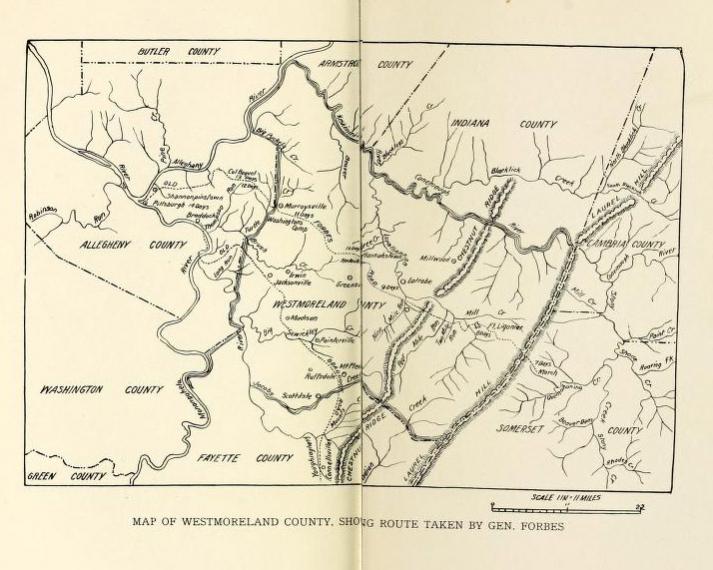
Early map of Westmoreland County
May 21, 2015 at 4:29 am #37447I do not remember finding that map, Marc. Thanks for dredging that up. My Blackfoot was born, supposedly, in Beaver County. Her husband was born in Greensburg, and they lived in Butler and Westmoreland counties before moving to IA. My other native lines were living near Huntingdon.
We are actually camping in Fayette County right now. We visited Fort Necessity, a recreation of Washington’s fort that saw the start of the French and Indian War, saw Braddock’s trail a couple of days ago, as well as Brownsville where Redstone Old Fort was located. We visited Nemacolin Castle that sits on the site of the fort. We drove the old Nemacolin trail which was the first federally-funded national highway.
A few years ago, we visited Huntingdon and saw where the Sinkeys were living and stopped at Fort Roberdeau, a recreation of a Rev War fort. A few years later, we visited Bedford, PA and saw Fort Bedford, a French and Indian War fort. It is a beautiful state and a favorite for us.
I bought a book on PA Indians here this time, but I have not looked at it yet. If it has anything interesting, I will add it. I passed up the book on PA chiefs, hoping I could find it cheaper online.
My cousin, years ago, gave me a copy of a book written by the son-in-law (I think), a Sinkey, of my “Blackfoot.” In it, he states that Indians in this area were “Cornplanter” Indians. That, however, does not necessarily mean that they were Seneca, as I have read that many different displaced tribal members lived on Cornplanter’s reservation.
Techteach
May 21, 2015 at 4:29 am #37449techteach;38209 wrote: I do not remember finding that map, Marc. Thanks for dredging that up. My Blackfoot was born, supposedly, in Beaver County. Her husband was born in Greensburg, and they lived in Butler and Westmoreland counties before moving to IA. My other native lines were living near Huntingdon.
We are actually camping in Fayette County right now. We visited Fort Necessity, a recreation of Washington’s fort that saw the start of the French and Indian War, saw Braddock’s trail a couple of days ago, as well as Brownsville where Redstone Old Fort was located. We visited Nemacolin Castle that sits on the site of the fort. We drove the old Nemacolin trail which was the first federally-funded national highway.
A few years ago, we visited Huntingdon and saw where the Sinkeys were living and stopped at Fort Roberdeau, a recreation of a Rev War fort. A few years later, we visited Bedford, PA and saw Fort Bedford, a French and Indian War fort. It is a beautiful state and a favorite for us.
I bought a book on PA Indians here this time, but I have not looked at it yet. If it has anything interesting, I will add it. I passed up the book on PA chiefs, hoping I could find it cheaper online.
My cousin, years ago, gave me a copy of a book written by the son-in-law (I think), a Sinkey, of my “Blackfoot.” In it, he states that Indians in this area were “Cornplanter” Indians. That, however, does not necessarily mean that they were Seneca, as I have read that many different displaced tribal members lived on Cornplanter’s reservation.
Was your Sinkey ancestor the Quaker who was teaching on the Cornplanter reservation?
After years of research I’ve been able to chip away at almost all the brick walls in our genealogy, but the Drybread brick wall persists.
This is my Drybread ancestor who was the patriarch of a long line of Indiana Drybreads:

William H Drybread b. 21 Oct 1799 Territory Northwest of Ohio River (present day Dearborn Indiana)- d. 29 Mar 1883 Nineveh, Indiana
His father was George Drybread (Jorge Drockenbrodt). Listed as born 14 Jul 1753 Huntingdon, Westmoreland, PA. Death 5 Jul 1832 Shandon, Butler, Ohio.
His mother Susannah G Sager listed as born 14 Jul 1760 in Dearborn County, Indiana, USA. Death 07 Oct 1839 in Shandon, Butler County, Ohio, USA.
The birth of his father George Drybread 1753 in Westmoreland is repeated in every family genealogy. However there was no Westmoreland County in 1753, or Fort Pitt, or even Fort Duquesne which wasn’t started until 1754. Looking at the maps of the time Queen Alliquippa’s (Mingo-Seneca?) town was near this location before the forts. Interestingly she married a German named Steinkonig who anglicized his name to Stoneking.
I’m wondering if George was really born in this area or was a child who emigrated from Germany. He appears on Westmoreland rolls in 1780. His assumed father is Andreas/Andrew or Frederick Druckenbrod. Andreas Druckenbrod is on the passenger list of the ship ‘Chance’ that landed Aug 8 1764.
Susannah Sager also could not have been born 1760 in Dearborn County which wasn’t in existence for another 50 years. Her father is listed as Mathias Sager b 8 Apr 1731 Alsace France, d. 1781 Sussex County NJ. Her mother Ellen b.1734 d. aft 1804.
I know the Drybread line of my grandfather was mixed, but don’t know how many generations before him it my have been mixed. It is his through his mother that I am linked to many other lines of people here.
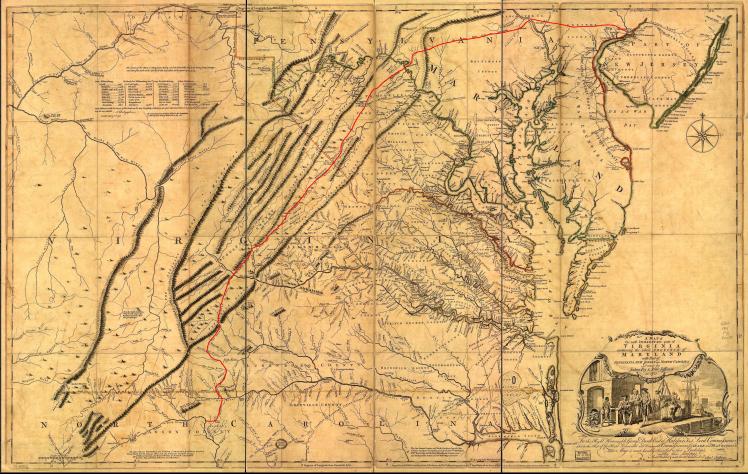
Here is another good 1755 map that shows Fort Duquesne area near the top. It also shows the Virginias/Carolinas:
 May 21, 2015 at 4:29 am #37450
Westmoreland had a Huntingdon too? The Sinkeys were just north of Huntingdon in what was first Bedford County and then Blair (I think). We think Richard’s son William was mixed. He was a ranger in the Revolution.
I do not think that the Sinkeys/Sankeys were Quaker, but we are not sure where they came from in England or Ireland. England had a Quaker Sankey from the right time to be a possibility. There was a Rev. Richard Sankey running around close by too, before he moved on to VA. We are not sure if he is a connection.
The Quakers who taught Cornplanter’s children were connected. The first wife of my Blackfoot ggggrandmother were those whos family moved out to western PA to teach his children.
There were Germans in the second location of my mixed family, near Shepherdstown, WV. I have come to believe that the Sinkeys and Greens in WV were related. Richard Sinkey is on the 1790 census with a George Green, and there is a Mary Green, wife of George Green buried near where Richard and his wife must be buried. Their headstones have disappeared.
Techteach
May 21, 2015 at 4:29 am #37451techteach;38212 wrote: Westmoreland had a Huntingdon too? The Sinkeys were just north of Huntingdon in what was first Bedford County and then Blair (I think). We think Richard’s son William was mixed. He was a ranger in the Revolution.
I do not think that the Sinkeys/Sankeys were Quaker, but we are not sure where they came from in England or Ireland. England had a Quaker Sankey from the right time to be a possibility. There was a Rev. Richard Sankey running around close by too, before he moved on to VA. We are not sure if he is a connection.
The Quakers who taught Cornplanter’s children were connected. The first wife of my Blackfoot ggggrandmother were those whos family moved out to western PA to teach his children.
Yes there are multiple Huntingdon Townships in modern Westmoreland County – North, East and South Huntingdon Townships.
The first wife of your ggggrandmother… Do you mean husband? Were they connected to the teacher at the Seneca school, Joseph Elkinton?
May 21, 2015 at 4:29 am #37454Oops. The wife’s family was involved. I don’t know how though. It is mentioned in the Sinkey memoir, I believe.
Techteach
May 21, 2015 at 4:29 am #37472My spoken Blackfoot lines also dead end in Beaver and Washington co PA… thanks for the info.
May 21, 2015 at 4:29 am #37479Seeker,
Wasn’t it you who several years ago posted a song by your Blackfoot ancestor that I tried to find out the words from a Sioux language speaker?
Techteach
May 21, 2015 at 4:29 am #37481techteach;38244 wrote: Seeker,
Wasn’t it you who several years ago posted a song by your Blackfoot ancestor that I tried to find out the words from a Sioux language speaker?
Techteach
I’m sorry, I don’t believe so. I don’t always trust my memory but that’s not sounding familiar to me. It seems I would remember that. Might have been another member?
May 21, 2015 at 4:29 am #37486Must have.
Techteach
May 21, 2015 at 4:29 am #37960I picked up a book titled ‘Annals of Buffalo Valley Pennsylvania 1755-1855’ by John Blair Linn. It’s about 500 pages published in 1877. The first pages talk about “the localities of the Indian tribes prior to William Penn’s arrival. (Oct 24 1682).”
“The Five Nations at they were then called (after 1714, “The Six Nations) occupied the territory north of the sources of the Susquehanna and Delaware rivers. After partial settlement of the country, these confederate tribes, were known among themselves by the name Aquanoschioni, united people, by the English. They were called the Six Nations by the French, the Northern Iroquois, settlers called them sometimes Mingoes and Maquais. This will explain the reason Shikellimy, the first noted inhabitant of Buffalo Valley, is called, in letters from Conrad Weiser and others, indifferently, an Iroquois chief, a Mingo chief, and a chief of the Six Nations.
Think ‘Haudenosaunee’ is what they meant by ‘Aquanoschioni.’
It goes on to mentions the Shawnee, and Muncy (Munsee), and talks about Shamokin, the trading paths, the 1755 Penn’s Creek Massacre.

I have an actual paper copy of the book with the pictures, not a web archive. It is well indexed, so if anyone has any ancestors or locations in this area they want me to look up let me know.
May 21, 2015 at 4:29 am #37961Some of the references to Shamokin in the Annals of Buffalo Valley:
Buffalo creek is mentioned by its name in the Indian deed of Octo-
ber 23, 1758. Penn’s is called John Penn’s creek in the same deed.
In the deed of July 6, 1 754, it is called Kaarondinhah. It was called
by the settlers, between 1754 and 1769, and marked on Scull’s map
of 1759, Big Mahany, and is so recited in deeds as late as 1772.
Thus the “Henry Christ” warrantee, (now in Monroe township,
Snyder county,) afterwards Herbster’s place, is described as in
” Buffalo township, formerly of the name of Shamokin, and bounded
by Big Mahany creek, lands of George Gabriel, Abraham Herr, and
others.” — Deed of Herbster to George Haines, 26th May, 1772. In
a deed from John Turner to John Harris, June, 1755, for an im-
provement, (now in Hartley township, owned byR. V. B. Lincoln,
Esquire.) the creek is called “Mahanoy.”
Shikellimy, sometime after Weiser’s visit, removed to Shamokin, now
Sunbury, as a more convenient point for intercourse with the
Proprietary Governors. On the 9th of October, 1747, Conrad
Weiser says he was at Shamokin, and that ” Shikellimy was very sick
with fever. He was hardly able to stretch forth his hand. His wife,
three sons, one daughter, and two or three grandchildren were all bad
with the fever. There were three buried out of the family a few days
before, one of whom was Cajadis, who had been married to his daugh-
ter above fifteen years, and was reckoned the best hunter among all the
Indians.” He recovered, however, from this sickness, and, in March,
1748, we find him at Weiser’s, in Tulpehocken, with his eldest son,
Tagheneghdourus. He died in April 1 749, at Sunbury, and the latter
succeeded him as chief and representative of the Six Nations.
Loskiel thus notices this celebrated inhabitant of our Valley :
“Being the first magistrate and head chief of all the Iroquois living
on the banks of the Susquehanna as far as Onondaga, [now Syracuse,
New York,] he thought it incumbent upon him to be very circumspect
in his dealings with the white people. He mistrusted the brethren
[Moravians] at first, but upon discovering their sincerity, became
their firm and real friend. Being much engaged in political affairs,
he had learned the art of concealing his sentiments; and, therefore,
never contradicted those who endeavored to prejudice his mind
against the missionaries, though he always suspected their motives.
In the last years of his life he became less reserved, and received those
brethren that came to Shamokin into his house. He assisted them in
building and defended them against the insults of drunken Indians,
being himself never addicted to drinking, because, as he expressed it,
he never wished to make a fool of himself. He had built his house
upon pillars for safety, in which he always shut himself up when any
drunken frolic was going on in the village. In this house. Bishop
Johannes Von Watteville, and his company, visited and preached the
Gospel to him. It was then the Lord opened his heart. He listened
with great attention, and at last, with tears, respected the doctrine of
a crucified Jesus, and received it with faith. During his visit to Bethle-
hem, a remarkable change took place in his heart, which he could not
conceal. He found comfort, peace, and joy by faith in his Redeemer,
and the brethren considered him a candidate for baptism. But hear-
ing that he had been already baptized by a Roman Catholic priest
Of the Indians who occupied Buffalo Valley, nothing can be posi-
tively ascertained, except that they belonged to the Muncy-Minsi
(or Wolf) tribe of the Lenni-Lenape, or original people. The
Valley was more a hunting ground than a residence. Some remains
have been found at prominent points aiong the river,” as, for instance,
at Colonel Slifer’s house, on the river, above the mouth of Buffalo
creek, some skeletons, evidently of one family only, were uncovered.
The large mounds were on the other side of the river, on Joseph
Nesbit’s place ; and the principal towns or villages, Chillisquaque,
at the mouth of that creek, south side, and Shamokin, on the island
and mainland, where Sunbury now stands.
-
AuthorPosts


- You must be logged in to reply to this topic.
