- This topic has 8 voices and 16 replies.
-
AuthorPosts
-
October 5, 2007 at 8:17 pm #3279
Hello,
I need help identify this type of clothing. Is it Native American (or inspired) or is it from another ethnic group?
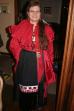
This is a picture of my gg grandmother.
Blackbird
October 5, 2007 at 8:17 pm #28602I forgot to add some more details.
The picture is of my gg grandmother, Mattie Meadows Baker. According to census records, her mother and father were born in the states of Virginia and South Carolina, respectively. Based on her looks and the census reocrds, I believe she is half Black and Indian. My family recognizes her as just Indian. In, at least 2 census years, she is recorded as MU (mulatto) and her father, Tom Meadows is recongized as Black. We have no other information regarding her. My maternal grandmother stayed with her when she was little and her description is that she was a short lady with long hair (which is no overstatement since my grandmother’s hair was almost waist length) close to touching her butt. My grandmother and other family members always believed she was from Ohio. She was born circa 1870s and lived her adult years in Louisiana and Arkansas. She married Lott Baker who was a mulatto (actual white father and black mother) from Claiborne Parish, Louisiana.
In the picture posted above, Mattie is wearing a tunic of some sort with possible ribbonwork over the chest, collar and cuffs of the tunic. It is belted and hooded. It’s of very simple construction and appears to made of some heavy cloth, perhaps broadcloth (stroud cloth). That’s all we have.
Any assistance is much appreciated.
Blackbird
October 5, 2007 at 8:17 pm #28623It looks to me like it could just be something then in fashion at the time. Do you know when it was taken?
October 5, 2007 at 8:17 pm #28634Linda,
Thanks for your response. No, I don’t have a date for the picture. Knowing that Mattie was born in the 1870’s and she appears rather older in the pic, I assume around the 1920’s or 1930’s. I suspect that picture is no earlier than the 1910 decade. It’s puzzling for me. Any thoughts or suggestions are greatly appreciated.
Blackbird
October 5, 2007 at 8:17 pm #28642The dropped waist, sailor style collar and dickey are like a middy dress, although the ribbon stripes are different. There’s a picture of one here:
http://vintagesewing.info/1920s/26-fcm/fcm-illus/26-01.jpg
The description is here,
http://vintagesewing.info/1920s/26-fcm/fcm-26.html
from a 1926 sewing course. I think they were popular from the 1910’s on. In fact, I wore a red middy blouse to my first day of first grade in 1956.
October 5, 2007 at 8:17 pm #28666Thanks Barbara,
I can see the resemblance. I will definitely be checking in with some of the elders on my mother’s side of the family to get more info.
Blackbird
October 5, 2007 at 8:17 pm #28668Don’t trust what the census says about race. In the south, nearly all Indians were classified as mulatto or black. You can see the ante-bellum legislation blatantly passed mandating that there were to be only two races in the south. Those that weren’t run off during Removal, ‘lucky’ enough to ‘pass’ as white’ were labelled ‘B’ or “M.” Trust more what your family says. She looks pretty Indian to me.
October 5, 2007 at 8:17 pm #28669Blackbird, My mother’s father’s mother was a Meadows and she was indian. Our Meadows came from Isle of Wight and New Kent, Va as mixed bloods (possibly Nansemand) to Granville Co, NC by 1740s and married Eno, Sappony, and Shakori when they resided here. My lines stayed in Person/Granville, NC but siblings and cousins migrated to Tenn, SC, KY, GA, Ala, Tx from 1800 on. The Meadows started out as Va indians. It may be impossible to determine an exact tribal origin.
October 5, 2007 at 8:17 pm #28678Linda wrote: Don’t trust what the census says about race. In the south, nearly all Indians were classified as mulatto or black. You can see the ante-bellum legislation blatantly passed mandating that there were to be only two races in the south. Those that weren’t run off during Removal, ‘lucky’ enough to ‘pass’ as white’ were labelled ‘B’ or “M.” Trust more what your family says. She looks pretty Indian to me.
Linda,
I agree. The census records many times offer a bad assessment for those using it for genealogy work for 19th century and early 20th century minority groups. To further complicate matters, the enumerators also injected their own biases into the process. I have one ancestor that is recorded as “B” in one count and marked as “Mu” in another; another was marked “W” in one census year and “Mu” in another. The confusion of the census makes using it as tool a tricky exercise, where one must read through the lines and cross reference as much as possible.
The Indian strand runs very strong in my mother’s family. Although my mother’s family considers themselves Black, many people, including Black people, wonder what their ethnic origins are. My mother is consistently asked what her nationality is and has even been told she looks Filipino. My maternal grandmother, traveling out west on a couple occasions, has been approached in the airports and streets by Spanish speaking individuals on both trips. My family has some distinctive characteristics: lighter skin with a reddish cast; slightly slanted gray, hazel or dark brown eyes; wavy to wavy-curly black hair; and heavy prominent cheekbones. My mother looks more Indian than my father, who is 1/2 Comanche. When I tell people I’m 1/4 Comanche, they usually assume it’s from my mother’s side if they seen her before.
Genetics can be a crazy mix and the census doesn’t slightly hint at the complexity of it or does it accounts for bias or the inefficiency of the social classification of “race”. For all purposes, that’s why I identify as a Mestee tri-racial from Louisiana.
Blackbird (Tuhwi)
October 5, 2007 at 8:17 pm #28679Dreaminghawk wrote: Blackbird, My mother’s father’s mother was a Meadows and she was indian. Our Meadows came from Isle of Wight and New Kent, Va as mixed bloods (possibly Nansemand) to Granville Co, NC by 1740s and married Eno, Sappony, and Shakori when they resided here. My lines stayed in Person/Granville, NC but siblings and cousins migrated to Tenn, SC, KY, GA, Ala, Tx from 1800 on. The Meadows started out as Va indians. It may be impossible to determine an exact tribal origin.
DreamingHawk,
Thank you for your response. I know info on Tom Meadows except he was recorded to be from South Carolina. His daughter, Mattie, according to census records was born in Alabama. That’s it. I will look deeper.
Blackbird (Tuhwi)
October 5, 2007 at 8:17 pm #28724Tuhwi,
I agree with all said regarding your Grandmother’s photo…and yet, just now when I brought up the front cover page of this book of the back view of this modern Winnebago regalia, the top of the woman on the far left immediately put me in mind of your Grandmother. The V shape at the neck, and the 2 ribbons coming down the sides. It may of course be and interesting coincidence. 🙂
October 5, 2007 at 8:17 pm #28727The v neck are scarves, and are not attached or apart of the womans clothing, ribbons on any ones clothing doesn’t mean anything everyone uses them.
The lady in the photo is wearing just every day dress of the time.
October 5, 2007 at 8:17 pm #28728Tom,
Do you see the things down their backs on the book front? Those are what I saw at the Meskwaki powwow that I talked to you about. One looks like it is made of ribbon, so that looks like a possible medium.
Techteach
October 5, 2007 at 8:17 pm #28736Yes I know what you are saying and yes the trailers probably are ribbon, my point is that if those are ribbons on Blackbirds family members dress ( and it looks like they are) does not mean that it is “Indian” because we all use ribbons, almost every culture and certainly in our times people can have ribbons on either store bought or sometimes applied to home made clothing.
The trailers could be made from ribbon on the cover of the book, if you look into “ribbonwork” traditions, you’ll find that it is a method of layering and cutting and sewing that creates the patterns. I’ve done it on a machine aswell as by hand, if you look at pre-1800 clothing , bags etc; you’ll see the beginings of this tradition.
I always look for the obvious, I try not to confuse the issues and just keep things as simple as possible, the lady is from a time that wearing anything “Indian” would have been doubtful., certainly if she wore this “down town”.
October 5, 2007 at 8:17 pm #28737Thank you to everyone for posting: Wachinika, TechTeach and Tom. I guess what was striking about my grandmother’s dress is the top part of the dress. The collar area has ribbons across it, which to a neophyte trained eye seems to be atypical to anything I’ve seen or believed to be American dress. Of course, there are regional variations one must take into account, but it just seemed so out of the ordinary. The ribbon seems to be broken at collar only by the attached hood. Also, it’s hard to see, but if you look closely, there is white trim around the neck similiar to what I’ve seen of the “Plateau” dress worn by Salish speakers of the Northwest. Those dresses have that trim because of the stroud cloth fabric used. My great grand who was from Oklahoma had some stroud leggings he wore with the white strip down them. This is what prompted me to question if the material was stroud cloth.
Who knows?
Blackbird
-
AuthorPosts


- You must be logged in to reply to this topic.

