
- This topic has 2 voices and 11 replies.
-
AuthorPosts
-
June 4, 2005 at 4:05 am #1576
Great news! Gertrude Kurath’s “Tutelo Rituals at Six Nations” is now available as a PDF at this address:
http://www.ethnomusicology.org/documents/publications/kurathtutelorituals.pdf
Look at the first six dances. They’re for women and are absolutely adorable. I’ve been able to decipher some of it and am eager to do more. Maybe someone will want to play with this at the campout.
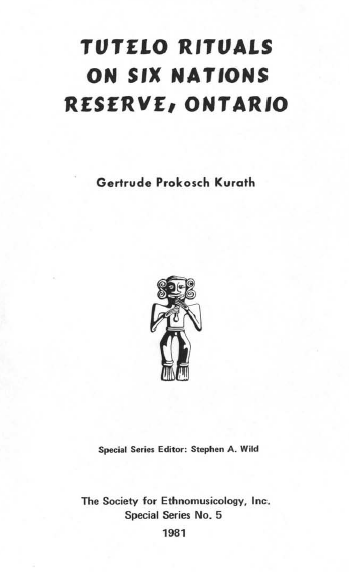
June 4, 2005 at 4:05 am #36579Here is a current link for the ‘Tutelo Rituals on Six Nations, Ontario’ book, by Gertrude Prokusch Kurath, published 1981 by The Society of Ethnomusicology, Inc.
 June 4, 2005 at 4:05 am #36580
I played with some of those dances a bit. I got confused when it seemed like there was an error. I had the impression no one had ever read what she wrote and I was just now finding a glitch. Or I didn’t understand a pattern. I tried tracking down the recordings but it’s likely they’ve been lost. If no one ever dubbed them the recording tape would be degraded by now. Although Tanya Harrison may have given me some of it, though I didn’t sift through it well enough to know.
I was just looking at your surnames and we may have Potters, Smiths and Pontius in common. The Pontius in particular is intriguing, it being such an unusual name. Where were yours located?
My Potters were in Vernon County, WI, the Smiths were in Sullivan County, Indiana at one point. I’ll have to go find where my pontius were.
June 4, 2005 at 4:05 am #36582My family has several musicians and I have recently shared this sheet music with them. I’m hopeful they will be able to bring it to life. I noticed in reading this, that one of her sources was Alexander T Cringan. He wrote an 1899 analysis of Haudenosaunee songs and made 50 minutes of phonograph recordings. They are housed at the Museum of Civilization here in Ottawa, where I live. I’m making enquiries as to how I can go about hearing them. I have not seen any source for recordings associated with this 1981 paper.
My Potters came from PA about 1800, they are a brickwall from there. They were in Darke Co Ohio in the early 1800s and Indiana by the mid 1800s. My oldest Smith came from WV, but I know from multiple sources that they changed their name to Smith – from what is an ongoing mystery.
The Pontius line is one I am strarting to research in depth. My mother has found a Pontius genealogy book I am going to read when I have time. My Johannes (John) Frederick Pontius was born 18 Aug 1718 in Alsace, Lorraine, France and died 1792 in Northumberland, PA 0 he maried Anna Catherine Zeller (Sellare) born 1725 in Tulpehocken, Berks, PA. The next generation was Johan Andrew Pontius b 29 Dec 1745 in Tulpehocken, died 1825 in Ross County Ohio.
My Pontius line married into Bayley/Miller lines out of West Virginia. This is not the line that passed the Blackfoot ID. But when I read some of Brenda Collins Dillon’s posts I started wondering if this line was also tied to the Saponi. On further research I discovered their genealogy ties to the Bunch family – as in Micajah Bunch.
What is interesting is some Pontius descendants had their name recorded as Punches. This has made me consider if Bunch/Punches/Pontius are perhaps all version of the same name. This is a question I hope to answer with my research in the Pontius book.
June 4, 2005 at 4:05 am #36583DNA Project:
http://pontiusgenealogy.com/dnaproject.htm – Note the haplogroups and alternate spellings of Pontious, Punches, and Poetgens. (Ponchus is another spelling in my genealogy)
June 4, 2005 at 4:05 am #36584Okay, cuz. We’ve got Johannes and Anna Sellaire in common, married in Tulpehocken, Berks, PA ca 1742. There is copious documentation on them, since they were Lutherans, who kept meticulous church records going way back. If you can’t find an easy to copy digital source I can always run down to Staples and get it copied for you. Although everything I have is handwritten by cousin Ada in the 60’s.
I looked at that site linked above and I didn’t see the detail I have, going back I think to the 1500’s in Germany. Let me know if you’re interested. I also have a copy of Oliverio’s dissertation if you’d like me to copy it for you.
June 4, 2005 at 4:05 am #36585Well hey Cuz! Yes I’m interested in looking at the Pontius genealogy and Oliverio.
June 4, 2005 at 4:05 am #36591Here is a computer-generated midi file from the sheet music for Harvest Dance 1-6. It’s rendered with a flute-like voice. http://ms-cs.ca/TuteloHarvestDanceSong.mp3
The words written for this song:
__________________________________
yowe danino howe danine
yowe danine yo – ho
yowe danine
yo – ho
hayona yo ha ha
jiwade ho
jiwade hone yonedi jiwade ho
yone hanewayo yuwine hewayo yuwine
hena ho hogine ho hone ji ji
wine go yo jigi hogine ho
yoho
__________________________________
I looked up the words on Tutelo.org – the ones I could find are yo=thanks and ho=hawthorn. Perhaps ‘ho’ also has a more general meaning like ‘plant’ or ‘plants’ That would make the yo-ho lines mean something like ‘thanks plants’.
June 4, 2005 at 4:05 am #36622It took some time but I was able to find someone at the Museum of Civilization who can make me a CD copy of Cringan’s 1899 recordings at Six Nations for a fee of $40.
Here is a summary of the recording:
Alex T. Cringan. Crin 1. 27 Iroquois songs and one speech at the Burning of White Dog. Transcribed by A.T. Cringan and published in the Ontario Archaeological Report for 1899. Songs from Archaeological Report of 1899. CRIN 1. III-I-217. Tape recording of Iroquois recordings originally transcribed by Alex T. Cringan, and published in the Ontario Archaeological Report for 1899.
1. Returning from the Hunt.
2. Returning from the Buffalo Hunt.
3. Scalping Song.
4. After Scalping Song.
5. Old Chief’s Favorite Song.
6. Second Chief’s Favorite Song.
7.-9. Wake Song.
10.-13. Four Night’s Dance Song.
14. Hit Stick Song.
15. Change Body Song.
16. Bean Song.
17.-19. Adonwah.
20.-21. Making Chief Song.
22.-24. Naked Dance Song.
25. Old Man’s Favorite Song.
26. Young Man’s Favorite Song.
27. Adonwah (Naming the Boy Song is here but broken)
28. Speech of Burning of White Dog.
June 4, 2005 at 4:05 am #36623Is it certain that those songs are Tutelo? Joanne Shenandoah sings an album of our songs, Matriach, but I don’t believe anyone’s aware that that is what they are. I can tell because they have the phrase, that sounds like, ‘now we a hee ah’ in them, like a chorus.
It may not be correct to assume that there are words per se in these songs. They were often chants, the ‘words’ are vocables and may not have any meaning. Or there might be a few words mixed in, and the rest are vocables. That’s a common pattern with NA songs.
June 4, 2005 at 4:05 am #36625Cringan identified several of his recordings as specifically Tutelo. Gertrude Kurath referenced this work for her Tutelo paper. Some of the songs he recorded are identified as Onondaga and Delaware, and he noted Tutelo songs being preformed by Onondaga singers. I believe the Kurath book identifies which recordings of Cringan’s are Tutelo and I will reference that when I get a copy of the recordings.
My understanding of the words/vocables is that they have meaning. But, the meaning of some or all of the words in these songs has been lost over time. Partly because knowledge was lost, but also because songs could mix different languages and could have phonetic additions to make them sound better. Vocables can still have meaning. Like in English ‘uh-huh’ is a vocable that means yes. A song vocable like ‘tra la la’ may or may not correspond to words from some language – but it conveys a sense of happiness.
I wonder how many vocables are actually based on words from forgotten languages. Like in my family there are songs passed down of German origin that sound like vocables to me because I don’t know many German words. And also if the song was passed down through non-German speakers the original words could have become garbled.
FYI – I completed an application to the Museum of Civilization for usage rights that would allow us to share these recordings on SaponiTown.com.
Thanks for letting me know about Matriarch! I will buy a copy and have a listen.
June 4, 2005 at 4:05 am #38193Linda;37301 wrote: It may not be correct to assume that there are words per se in these songs. They were often chants, the ‘words’ are vocables and may not have any meaning. Or there might be a few words mixed in, and the rest are vocables. That’s a common pattern with NA songs.
I think you are right about that. Perhaps the meaning I’m looking for is not in the words themselves, but in the act of singing together the same words ancestors sang.
-
AuthorPosts


- You must be logged in to reply to this topic.
