
- This topic has 0 replies, 1 voice, and was last updated 8 years, 5 months ago by
 MarcSnelling.
-
AuthorPosts
-
April 10, 2018 at 6:31 am #48741
Proto-Dakotan Swadesh list #17
*Hokduwa, all.I have found out more since I discussed this term previously. My map for this word also had some errors, so I deleted it and will have to redo it. I had considered the possibility that Chiwere /Broge/ and similar terms in Dhegigan may have been distantly cognate with *Hokduwa, but it just seems too much like another word. And it turns out in fact to be another word; #190 on the Swadesh list, “round” in Chiwere is also /Broge/ (from *Poroshka). Clearly then the word for ‘round’ came to be used for ‘all’ in Chiwere and it is not from *Hokduwa after all. Moreover, I found that there is another Chiwere word /Dhanyii/ with a similar meaning “whole, entire” that clearly is related to the others. The northern groups are still unusually split between two different forms of the word, indicating more recent migration of one of them, possibly from the Beaver Wars. I am fairly certain now about the original protoform being *Hokduwa or similar, taking into account the evidence from word #4 *Mindehokduwa “we”.
1. WOCCON: ?
2. CATAWBA /Kunhip/ ?<*Kudep <*Kudepa <*Kudeba <*Kudewa <*Xukdowa <*Hokduwa
3. YESAN /Huk/ <*Hok <*Hokduwa
4. OFO /Chupii/<*Xubii <*Xuwii <*Huwii <*Hudewii <*Huduwii <*Hukduwii <*Hokduwa
5. BILOXI /Kode/ <*Kudewa ^
6. QUAPAW /Iizaniin/ <*Iitsaniin <*Hetsaniin <*Hetsanii <*Hetsonii <*Hetsunii <*Hetsuwii <*Hetuwii <*Huduwii ^
7. OMAHA-PONCA /Zanii/ <*Zaniin <*Iizaniin ^
8. KANSA /Zaniin/ ^
9. OSAGE /Thanii/ <*Zanii ^
10. HOCHAK /Henanich/<*Hentsanint <*Hetsaniin ^
11.CHIWERE /Broge/ = “round”
12. MANDAN ?
13. DAKOTA /Ataya/ <*Atsaya <*Hetsaya <*Hetsanyii <*Hetsanii ^
14. NAKOTA /Kowa/ <*Hakowa <*Hakuwa <*Hokuwa <*Hokduwa
15. HIDATSA /Eetsa/ <*Hetsa <*Hetsanii ^
16. CROW /Xaxuwa/ <*Hakuwa ^Rankin mentions #6-9 as being from PMV *Zaniin, but does not take this back to PS. He also notes #15 as including *E “that”. #11 is ascribed to *Wro “round”; the others are not mentioned on his website.
Proto-Dakotan Swadesh word #18
*Otahon, many.The following is my conjecture on how the words for ‘many’ could be related (Yesan: /Ohon/) , and how they might all come from an original *Otahon or similar.
1. WOCCON: ?
2. CATAWBA /Yekenre/ ?<*Yexen’e <*Yahen’ <*Nyahen <*Dahon <*Tahon <*Otahon
3. YESAN /Ohon/ <*O’ohon <*Otohon <*Otahon
4. OFO /Ophii/ <*Tophii <*Towhii <*Tohii <*Tahii <*Tahiiwn <*Tahun <*Tahon ^
5. BILOXI /Tahii/ ^
6. QUAPAW /Zhohii/ <*Johii <*Dohii <*Tohii ^
7. OMAHA-PONCA /Huwalii/ <*Huwanii <*Huwan <*Huwen <*Hun <*Ahun <*Tahun ^
8. KANSA /Hiiyu/ <*Hiiw <*Huw <*Huwen ^
9. OSAGE /Hiiyu/ ^
10. HOCHAK /Rohan/ <*Dohan <*Tohan <*Tohon <*Tahon ^
11. CHIWERE /Rohan/ ^
12. MANDAN /Hun/ ^
13. DAKOTA /Ota/ <*Otan <*Otahn <*Otahen <*Otahon
14. NAKOTA /Oda/ <*Ota ^
15. HIDATSA /Ahu/ <*Ahun ^
16. CROW /Ahu/ ^Rankin picked up on the relationship between the words at #3, 8, 9, 12, 15 and 16 above, and proposed the original PS word as *Ahun . No mention of the others.
(The T in #5, 13, 14; the R in #10 & 11, and the Zh in #6 are hard to explain appearing in so many places, without an original T in there, but he seems to have missed all those…)Proto-Dakotan Swadesh word #19
*Dumba, some.The Omaha, Kansa and Osage words for ‘some’ suggest the sense was “an indistinct number approximating possibly two (*Nunpa) or four (*Topa).” All of the words for ‘four’ in those languages are quite similar – Omaha /Duba/ ‘four’ alongside /D’uba/ ‘some’; Kansa /Toba/ four and /Doba/ some, and in Osage indeed both words have coalesced, as the same form /Doba/ can mean both ‘four’ and ‘some’.
The others are just barely similar enough to reconstruct a common ancestor *Dumba (pronounce DOOM-bah), probably formed from influence of both *Numpa ‘two’ and *Topa ‘four’.
This is also the first word on the list missing from Yesan. What the Yesan word for ‘some’ really was is anybody’s guess, and unfortunately the words have developed too differently to predict any regular changes with certainty. The nearest available relative, Biloxi, has /China/ (pronounce CHINN-ahh) but Yesan is unlikely to have taken that kind of path in my opinion. I think Yesan being highly conservative tended to preserve the basic skeletal sounds of the originals in many cases, often with some simplification or dropping of unaccented syllables. Because ‘two’ and ‘four’ in Yesan are /Nompa/ and /Topa/, I would speculate that their similarity with ‘some’ was preserved better than in most other languages, and that the vowel followed a parallel course to /Nompa/<*Nunpa , with the u in *Dumba becoming o, hence my reconstruction for Yesan ’some’ is *Domba (Domb), Dombai’.
1. WOCCON: ?
2. CATAWBA /Pe/ <*Dumpe <*Dumba
3. YESAN ?
4. OFO ?
5. BILOXI /China/<*Chuna <*Chona <*Jona <*Jonda <*Jumba <*Dumba
6. QUAPAW /Kiizon/ <*Chiizon <*Chiyon <*Jona ^
7. OMAHA-PONCA /D’uba/<*Duba <*Dumba
8. KANSA /Doba/ <*Duba ^
9. OSAGE /Doba/ ^
10. HOCHAK /Hota/ <*Honta <*Hyonta <*Jonda ^
11. CHIWERE /Iiyan/ <*Hyan <*Hyon’ <*Hyonta ^
12. MANDAN /Tu’sh/ <*Tu’m <*Du’m <*Dumba
13. DAKOTA /Ungee/ <*Unge <*Umba <*Numba <*Dumba
14. NAKOTA /Aba/ <*Oba <*Uba <*Umba ^
15. HIDATSA /Nuwa/ <*Numa <*Numba ^
16. CROW /Hawa/ <*Nawa <*Nowa <*Nuwa ^Rankin has the PS elements of the Biloxi word /China/ as *Shi-ran, “demonstrative” + “quantifier”. He has 7,8, and 9 as from PMV *Dopa ‘some’, which he says is connected with Mandan /Tu’sh/ and also includes the PS *-Pa interrogative. Additionally, he claims to identify in Crow /Hawa/, the PS *Ha- interrogative.
William Meuse
Proto-Dakotan Swadesh word #20
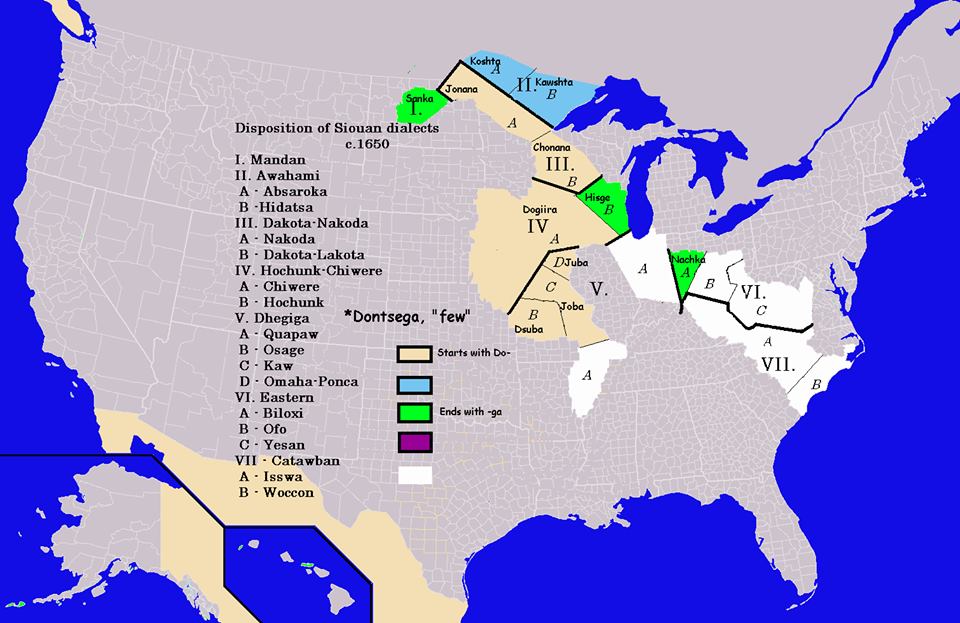
*Dontsega, few.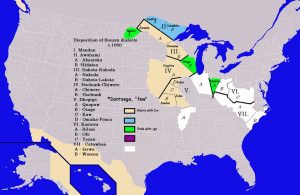
The attached map shows what I found for this word; most of the east is blank white, since I could not discover the word for ‘few’ in Yesan, Catawba, Woccon, Ofo, or Quapaw. We cannot be absolutely certain all these different words came from the same parent, but on the assumption they did, I have calculated *Dontsega as the likeliest ancestral form. The ones shown in tan all preserved a similar first syllable from *Do, while those in green seem to have focused on the last part of the word. Usually it is unstressed elements that fade out, so this would suggest differing accentuations in the original *Dontsega were picked up by different populations.
This illustrates the difficulty of guessing at the Yesan word with no near neighbours and much disparity among the available forms. On the assumption that *Dontsega is correct for proto-Dakotan “few”, I would “Tutelo-ize” this as */Donska/, this would not surprise me at all. But this is really just my stab in the dark , I certainly cannot authorize that as vocabulary and think it would be proper to defer to Chief Haithcock on any question such as the future of linguistic development.
William Meuse
Attachments:
You must be logged in to view attached files. -
AuthorPosts
- You must be logged in to reply to this topic.
