
- This topic has 0 replies, 1 voice, and was last updated 8 years, 5 months ago by
 MarcSnelling.
-
AuthorPosts
-
April 10, 2018 at 6:37 am #48746
Proto-Dakotan Swadesh word #21
*Hanwetsa, other.I changed my mind about this one a few times, but after close examination I have settled on *Hanwetsa as being the most likely as the original ancestor of these words.
Two of the terms drifted over into coalescing with different concepts, in Ofo /Angliif/ and Crow /Hawata/.The Ofo word for ‘other’ /Angliif/ is notable because it also is the word for ‘foreign’ – as in “foreign language, any other language than Ofo”, particularly English, and by extension, Americans or any non-Ofo people. As Dr Rankin no doubt correctly states, this is indebted to the 17th century French term ‘Anglois’. I would be willing to bet that the old word for ‘other’ was similar enough in sound, that it was part of the reason the Ofo started saying /Angliif/ even in the sense to mean ‘other’ or ‘another’ of anything. Thus based on the cognates, I have postulated it as replacing a term such as *Anwiits as shown below.
The Crow word /Hawata/ ‘other’ is also the word for the number ‘one’. The suggests almost an early Semitic conception where instead of saying ‘the one (abc), and the other (xyz)’, they would say ‘the one (abc), and the one (xyz)’. However, it seems more likely that the word /Hawata/ for ‘other one’ was adopted for the number one, rather than vice versa, since it seems better to match this set of words than it does the other terms for “one’.
The Yesan word for “other, another” is missing and is not much easier to guess than the previous two words on the list, but we might ‘Tutelo-ize’ it as perhaps *Anwets , Anwetsi.
1. WOCCON: ?
2. CATAWBA /Niipe/<*Niiwe <*Niiwets <*Niwetsa <*Anwetsa <*Hanwetsa
3. YESAN ?
4. OFO /Angliif/ <*Anwiits <*Hanwets <*Hanwetsa
5. BILOXI /Kiiyowa/<*Kiinowa <*Keenewa <*Heenwa <*Henwa <*Hanwan <*Hanwets ^
6. QUAPAW /Iiman/<*Eenman <*Henman <*Hanman <*Hanwan
7. OMAHA-PONCA /Ama/<*Anman <*Hanman ^
8. KANSA /Onmon/ <*Anman ^
9. OSAGE /Onmon/ ^
10. HOCHAK ?
11.CHIWERE /Geehnaha/ <*Keenewa ^
12. MANDAN ?
13. DAKOTA /Unman/ <*Onman <*Anman ^
14. NAKODA ?
15. HIDATSA /Iiha/
16. CROW /Hawata/ <*Hanwata <*HanwetsaProto-Dakotan Swadesh word #22
*Tsontsa, one.Finally we have a word with no data missing. As noted in yesterday’s word, in Crow the forms from *Tsontsa “one” and *Hanwetsa “the other” have coalesced into one word, /Hawata/.
1. WOCCON: /Tonee/ <*Tontsa <*Tsontsa
2. CATAWBA /Nepen/<*Dewen <*Dowantsa <*Dontsa <*Tontsa ^
3. YESAN /Nonsa/ <*Nontsa <*Dontsa ^
4. OFO /Nufha/<*Nonsa ^
5. BILOXI /Sonsa/ <*Tsontsa ^
6. QUAPAW /Miinqtii/<*Wiinxtsii <*Wiyanxtsii <*Wyantsii <*Wyantsa <*Wantsa <*Dowantsa ^
7. OMAHA-PONCA /Wiinaqchii / <*Wiyanxtsii ^
8. KANSA /Miinxchii/ <*Wiinxtsii ^
9. OSAGE /Wiinxtsii/ ^
10. HOCHAK /Hizhan/ <*Hiyan’ <*Hiyanka <*Hyantsa <*Wyantsa ^
11.CHIWERE /Iiyanka/ <*Hiyanka ^
12. MANDAN /Manxanan/ <*Wanxanan <*Wantsanin <*Wantsa ^
13. DAKOTA /Wanzhii/ <*Wantsii <*Wantsa ^
14. NAKODA /Wanzhii/ ^
15. HIDATSA /Duwetsa/ <*Dowetsa <*Dowantsa ^
16. CROW /Hawata/ <*Hawetsa <*Dowetsa ^Basically, Rankin sees only #1-5 and #15-16 as related, and being from Proto-Siouan *Runsa. He considers #6-14 to be from a PMV ‘replacement term’ that he does not specify.
Proto-Dakotan Swadesh word #23
*Nunpa, two.This one should be easy and straightforward. No one disputes that all the words for “two” are related and nearly the same in all languages.
It is /Nunpa/ in Lakota-Dakota, /Nunba/ in Nakoda, /Nunp/ in Hochak and Mandan, /Nunpha/ in Ofo, /Nunpere/ in Catawban, /Numpere/ in Woccon, /Nuwe/ in Chiwere, /Dupa/ in Crow, /Dopa/ in Hidatsa, /Nonpa/ in Quapaw and Biloxi, /Nompa/ in Yesan, /Nonba/ in Kaw, /Thonba/ in Osage, and /Thawnba/ in Omaha.
Clearly they all start with the sound *N-, except where *N- has drifted into *D- in Hidatsa-Crow, and even further into *Th- in Omaha & Osage.
The main contenders for the original word for ‘two’ then should be either *Nunpa or *Nonpa, I have chosen to go with *Nunpa although both the -u- and the -o- are well represented across the spectrum. There would be little appreciable difference in the sounds of /-np-/ and /-mb-/, /-mp-/, etc.
Notwithstanding the above, Robert Rankin has reconstructed the Proto-Siouan word for ‘two’ as *Runpa. Although none of these words in any language here start with R, this is in keeping with his theory or assumption that there were once a lot more R’s in the language.
Proto-Dakotan Swadesh word #24
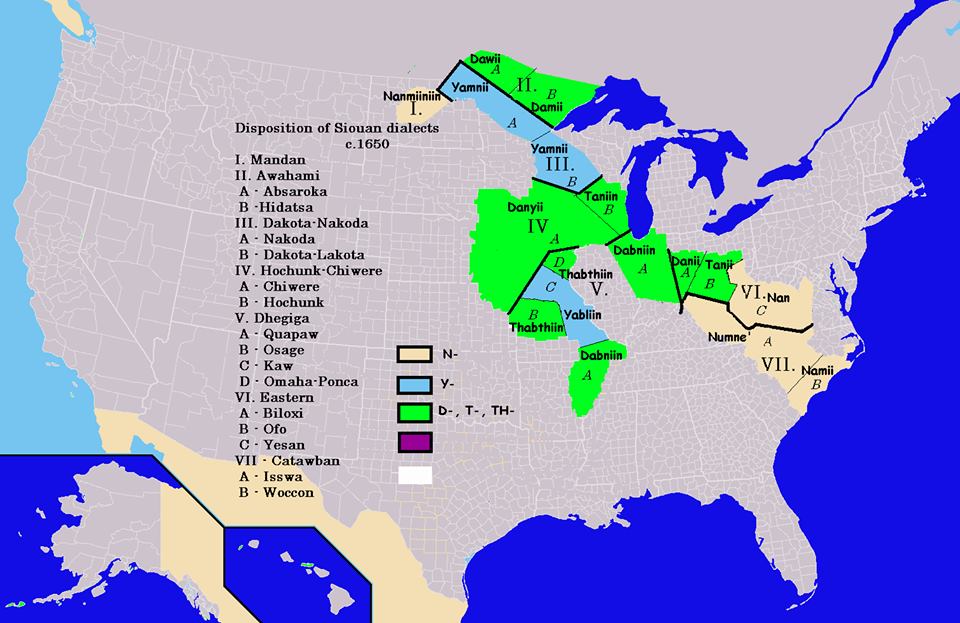
*Nameni, three.As the attached map shows, all words for ‘three’ are related and divided among initial N-, Y-, or D. The D- here is certainly old, but the predominance of N- in the east (Yesan /Nan/) as well as in Mandan, an early offshoot, swings the probability of its being earlier. I have thus reconstructed the ancestral form as *Nameni (*/Namenii/).
Rankin’s reconstruction of the ancestral form of these is *Rawrin. My chart would look totally different from his, which you may see for yourself all on one page at his site here: http://csd.clld.org/parameters/134#4/39.63/-93.31
William Meuse
Attachments:
You must be logged in to view attached files. -
AuthorPosts
- You must be logged in to reply to this topic.
