
- This topic has 0 replies, 1 voice, and was last updated 8 years, 6 months ago by
 MarcSnelling.
-
AuthorPosts
-
April 10, 2018 at 6:56 am #48756
Proto-Dakotan Swadesh word #25
*Topa, four.This one must be the least controversial reconstruction of the 205 words on the list, since it is the only word where Rankin and I both got exactly the same result (*Topa = ‘four’). [at least he didn’t say *Ropa!
 =) ]
=) ]/Topa/ is the word in Biloxi, Ofo, Dakota and Hidatsa, as well as perfectly good Yesan (/Top/ or /Topa/, with article /Topai’/). It is also /Top/ in Mandan.
Other variations include: Kaw /Toba/; Nakoda & Osage /Doba/, Omaha /Duba/, Crow /Shopa/, Quapaw /Towa/, Chiwere /Towe/, Hochak /Jop/. The Catawba /Puropre/, /Puprere/ is probably also from /Topa/.William Meuse
Proto-Dakotan Swadesh word #26
*Cheshon, five.The words for ‘five’ followed two different routes, the more conservative route represented in Yesan /Kiisan/, Ofo /Kiifan/, Biloxi /Kisan/, Mandan /Kiixunh/, Hidatsa /Kiixu/, Crow /Chiiyaxu/.
The less conservative one is seen in Quapaw & Kaw /Satan/, Omaha /Satawn/, Osage /Dhaton/, Hochak /Sachen/, Chiwere /Thatan/, Dakota & Nakoda /Zaptan/.
(Note: the Quapaw and Kaw word for ‘five’ /Satan/ may be triggering for some since it means the devil in Hebrew and many other languages. In the Bible, it is only the devil’s servants who fear the devil, while the servants of the Lord God fear only God. I serve the Lord God and not the devil, so I have no fear of the devil in the first place, but the Quapaw and Kaw words for ‘five’ are certainly just a complete coincidence with no influence from Hebrew…)
The conservative forms are probably via something like *Kiishon, and the less conservative ones via *Thachen or the like. Thus I am guessing *Cheshon as the ancestor of *Kiishon, *Thachen, and all these other words.
Rankin correctly identified the two groups of words for ‘five’, but did not connect them to a common origin, preferring to take them back to proto-Siouan *Kisun and *Isaptan, respectively.
Proto-Dakotan Swadesh word #27
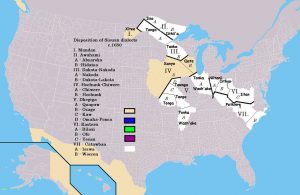
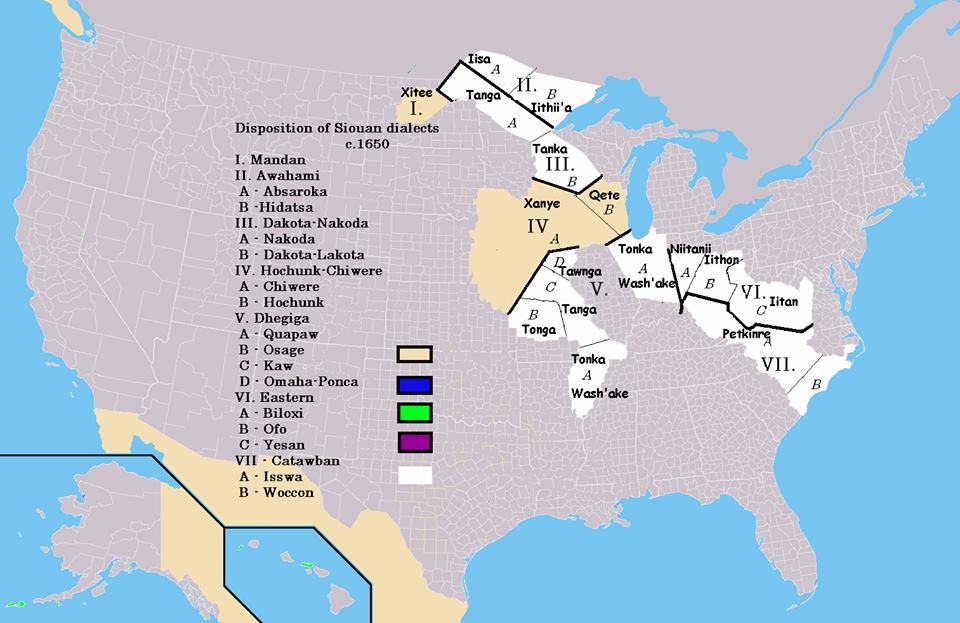
*Niitsanga, large, big.The map shows the distribution of words for ‘large, big’ in each language. The initial N- is only in Biloxi /Niitanii/ and may have some other explanation since there is little sign of it elsewhere, but at the least the original word probably included *Iitsanga. In Yesan it is /Iitan/, /Iitanii/ or /Iita’iin/ with article.
I reconstructed two later words on the list as originally formed from compounds including *Niitsanga: ‘Lake’, *Menin-nitsanga (water-large) and ‘Mountain’, *Minyanstek-baxee-nitsanga (Rock-accumulation-large).
The language areas colored tan seem to share a path that could also easily be from *Nitsanga / *Itsanga. However, Rankin connected Hochak /Xete/ and Chiwere /Xanye/ with a different root, and Mandan /Xte/ from still another. For the others (except Catawba) he gives the ancestral word meaning ‘large’ as *Ihtanre.
Proto-Dakotan Swadesh word #28
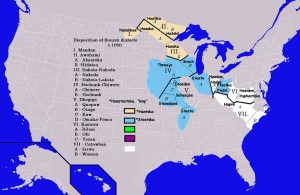
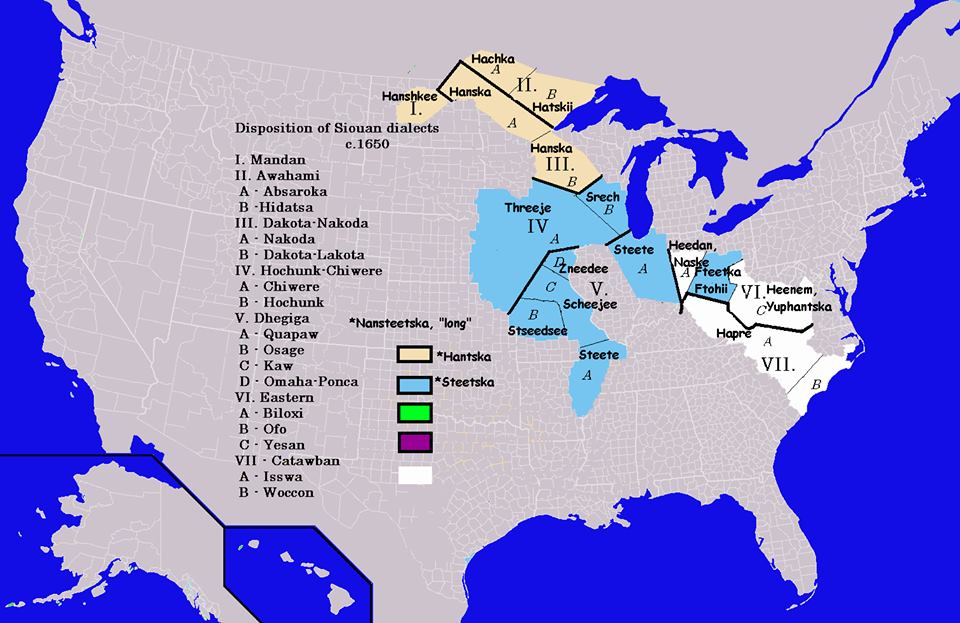
*Nansteetska, long.The northernmost words for “long”, shown on the map in tan, seem to come from *Hantska. Those in blue seem to have come from *Steetska. The Ofo /Fteetka/ is the breakthrough showing the ending in -ka was shared by both groups.
So aside from *Hantska and *Steetska, we also have Yesan /Yumphantska/ and Biloxi /Naske/. As with yesterday’s word (*Nitsanga “large”), Biloxi is the only language showing an initial N-. but it still seems to fit as older than the H- in *Hantska, so we can probably take both *Hantska and /Naske/ back to an earlier *Nantska. That leaves us with *Nantska, *Steetska, and /Yumphantska/. The Yesan word seems to have added some other compound element to *Hanska, not seen in any others, so rejecting that one now leaves us with just *Nantska and *Steetska. Therefore *Nansteetska is my proposal for the original word that could have become both *Steetska (by abbreviation) and *Nantska (by elision).
Many of these words for “long” can also mean “tall”; the Yesan /Yumphantska/ seems to be the regular word for ‘long’, applied to the ‘longhouse’ (Iroquois style dwelling), it also came to mean ‘rectangular’. The other Yesan word, /Heenem/, is actually a verb, that can mean ‘to be long, tall, far’ and is probably connected with “there” /Heede/, cf. the Catawba /Hapre/, long, which is the same as the word for ‘over there’.
Although the Yesan term for ‘long, tall’ is not lacking, Oliverio analysed the vocabulary words /Wustetka/ partridge, and /Mastetka/, pheasant, as meaning ‘tall bird’ and reconstructed another (unattested) Yesan word for ‘long’, *Stetka, parallel to the western forms. These bird names may well show vestiges of the original *Nansteetska, but the form for ‘long’ itself seems to have morphed into /Yumphantska/, so i am doubtful as to whether her *Stetka was used in Yesan.
As for Rankin, he ascribes all the blue areas of the map (the *Steetska group) to Proto-Siouan *Srete, ‘long, tall’; but the tan areas, plus Biloxi /Naska/ and Yesan /Yumphantska/, to a different Proto-Siouan word for ‘long, tall’, *Hanske.
William Meuse
Attachments:
You must be logged in to view attached files. -
AuthorPosts
- You must be logged in to reply to this topic.
