
- This topic has 0 replies, 1 voice, and was last updated 8 years, 6 months ago by
 MarcSnelling.
-
AuthorPosts
-
April 10, 2018 at 7:47 pm #48790
Proto-Dakotan Swadesh word #33
*Petsushka, short.Several of these words for ‘short’ seem to be related and from *Petsushka;
but Quapaw /Tapa/, Kaw /Dapa/ and Osage /Dsapa/ may have a separate origin since I could not connect them with the others. Same goes for Mandan /Sanank/, though it is remotely possible that one is from the last part of Dakota /Pteechena/.
Rankin also connected /Tapa/, /Dapa/ and /Dsapa/ as being from PMV *Tape, “short”, observing “the root is restricted to PMV”. He does not mention these other words that I have traced to *Petsushka, however.
1. WOCCON: ?
2. CATAWBA /Muneksayre/ <*Muneksa <*Menuksa <*Petuska <*Petsushka
3. YESAN ?
4. OFO /Tuska/ <*Tushka <*Tedushka <*Pedushka <*Petushka ^
5. BILOXI /Tuduxka/ <*Tudushka <*Tedushka ^
6. QUAPAW /Tapa/
7. OMAHA-PONCA /Cheeshka/ <*Chushka <*Tsushka <*Petsushka
8. KANSA /Dapa/
9. OSAGE /Dsapa/
10. HOCHAK ?
11.CHIWERE /Shwiishje/ <*Shushka <*Chushka ^
12. MANDAN /Sanank/
13. DAKOTA /Pteechena/<* Pedeeshta <*Pedushta <*Pedushka ^
14. NAKODA /Pteejena/<*Pteechena ^
15. HIDATSA /Paduwii/ <*Pedush <*Pedushka ^
16. CROW /Pumii/ <*Puwii <*Paduwii ^Proto-Dakotan Swadesh word #34
*Ketsukets, narrow.Reconstruction is hampered by the fact that I could only learn terms for ‘narrow’ in 6 westerly languages, as shown, and I am missing the others, including Yesanechi. So this is only a temporary and tentative reconstruction, and of course if we could miraculously converse with a proto-Dakotan speaker from centuries ago, we might find his language was actually completely different from what anyone has guessed…
Rankin mentioned only 2 words, Hochak /Suksik/ (also /Ksuksik/) and Mandan /Kshuko’sh/, and from just these two, proposed *Kisuke as the proto-Siouan term for ‘narrow’, which is not too far from my result, since i relied on Mandan as probably the most conservative of these.
1. WOCCON: ?
2. CATAWBA ?
3. YESAN ?
4. OFO ?
5. BILOXI ?
6. QUAPAW ?
7. OMAHA-PONCA ?
8. KANSA /Hoshcha/ <*Hoshucha <*Ketsucha <*Ketsuksa <*Ketsukets
9. OSAGE /Uthuhii/ <*Utsuhii <*Ketsuhii <*Ketsuchii <*Ketsucha ^
10. HOCHAK /Suksik/<*Kesuksik <*Ketsuksik <*Ketsukets
11.CHIWERE ?
12. MANDAN /Kshuko’sh/ <*Ketsukets
13. DAKOTA /Chistiina/ <*Kistiina <*Ketsiina <*Ketsuna <*Ketsuta <*Ketsuka <*Ketsuksa ^
14. NAKODA ?
15. HIDATSA ?
16. CROW /Chuwa/<*Tsuwa <*Tsuta <*Ketsuta ^Proto-Dakotan Swadesh word #35
*Xableeqa, thin.Today’s word *Xableeqa “thin” is as opposed to “thick” *Shoga, not to be confused with yesterday’s word “narrow” *Ketsukets, the opposite of *Braska “wide”. The ideas may be similar, but just as in English, there are always different words for ‘thin’ and ‘narrow’.
The pronunciation of *Xableeqa would be not too far off from the Yesan form for “thin”, /Hableeha/, both forms should be intelligible to each other, because the X and Q both represent harder H sounds. (The difference between X and Q is, the Q is sharper than X, but not quite as solid as K. The X is an H that is raspy enough to sound almost like SH)
All the available words for thin are:
1. WOCCON ?
2. CATAWBA ?
3. YESAN /Hableeha/
4. OFO /Kiiska/ ( = small)
5. BILOXI /Hadeehii/
6. QUAPAW /Bdeeka/ <*Bleeqa <*Xableeqa
7. OMAHA /Btheeka/
8. KAW /Bleeka/
9. OSAGE /Btheeka/
10.HOCHAK /Pere/
11. CHIWERE /Breege/
12. MANDAN ?
13. DAKOTA /Ziiziipena/ – possibly different word
14. NAKODA /Ziiziimyena/ – ” ” ”
15. HIDATSA /Xadaxii/
16. CROW /Xapii/Rankin derives #3 and #5-11 from Proto-Siouan *Warehe, ‘thin’, and Hidatsa /Xadaxii/ (or /Xaraxxi/) from another PS word for ‘skinny, thin’, *Xarahe. He gives Dakotan as /Ziipedan/ and says it and Crow /Xapii/ come from two unspecified PS terms for ‘flat’.
William Meuse
Proto-Dakotan Swadesh word #36
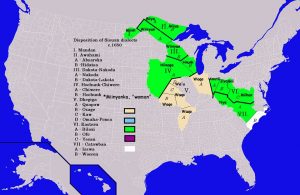
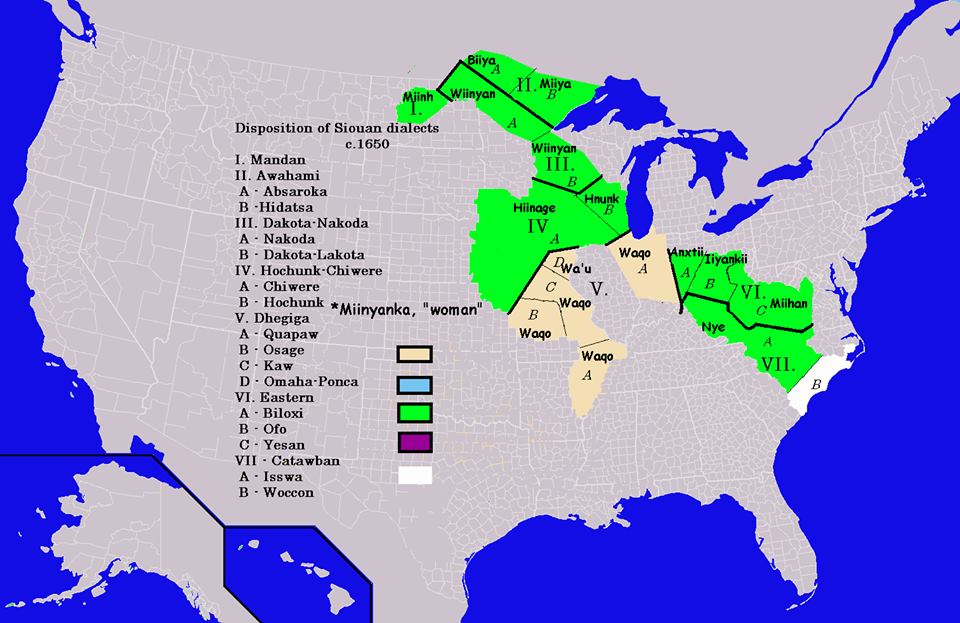
*Minyanka, womanHere is a map showing all the different words for ‘woman’ in each Siouan language, that must have come from an original word pronounced as *Miinyanka. (Yesanechi: /Miihan/).
The Hochak word /Hnunk/ has coalesced with a similar term for ‘daughter’, so that /Hnunk/ in Hochak means both ‘daughter’ and ‘woman’.
The Hochak /Hnunk/ and Chiwere /Hiinage/ by themselves can be taken back to Proto-Hochunk-Chiwere *Hiinanke, this *Hiinanke then fits in well with all the other languages, showing that the original Proto-Dakotan form was surely *Miinyanka or similar.The Dhegigan subfamily, shown in tan, all use /Waqo/ or similar, but that could also easily be from *Miinyanka.
Derivative compounds among my reconstructions include *Kutha-miinyanka, “wife”. In Quapaw the word for ‘wife’ is also /Waqo/, but there are separate terms for ‘wife’ in all the other languages. Chiwere /Hiinage/ can also be used to mean ‘wife’ in addition to their other word for wife (/Iitamii/).
The word I reconstructed for ‘stone’, *Miinyanstek, also seems to have been semantically related, my intuition from the evidence is that the concept was as a “woman’s” implement for cooking and fires in the home, like a hearth. Stone is word #156 on the Swadesh list, so this can be discussed more fully later.
Rankin derived all the words in green on the map to what he says is the Proto-Siouan term for woman or sister, *Winhe. (Hochak /Hnunk/ has a double derivation from *Iyunke ‘daughter’.) However, he considers the tan words to come from Proto-Siouan *X’ohe meaning ‘old’. Apparently in the sense of an ‘old woman’ as a term of respect, gradually becoming used for any woman – but I consider this highly dubious that Quapaw /Waqo/ etc. came from a word meaning ‘old’.
William Meuse
Attachments:
You must be logged in to view attached files. -
AuthorPosts
- You must be logged in to reply to this topic.
