
- This topic has 0 replies, 1 voice, and was last updated 8 years, 3 months ago by
 MarcSnelling.
-
AuthorPosts
-
April 10, 2018 at 7:58 pm #48795
Proto-Dakotan Swadesh word #41
*Chenanku, husband.None of the languages shows a strong parallelism between the words for ‘husband’ and ‘wife’; the strongest, that of Yesan /Tamank/ and /Tamiihen/, could be superficial and the result of some reanalyses to make them more parallel. The original ancestor of these words works out to *Chenanku. A more parallel form such as *Kutha-nanku is conceivable, but lacking evidence. The Mandan word if known might shed more light, but I haven’t found it yet.
See yesterday’s word *Kutha-miinyanka ‘wife’ for an explanation of why the Yesan word for ‘husband’ is surely /Tamank/, with article /Tamankii/, and not /Mankii/ as other sources may suggest.
1 WOCCON ?
2 CATAWBA /Niikche/
3 YESAN /Tamank/ <*Temanku <*Tenanku <*Chenanku
4 OFO /Thiinto/<*Tenento <*Tenanku ^
5 BILOXI /Yiinka/=’spouse’
6 QUAPAW /Eeknanke/<*Eegnanke <*Engnanke <*Hengnanke <*Henanku <*Chenanku
7 OMAHA /Eegthangee/ <*Eegnanke ^
8 KAW /Niika/ = ‘man’
9 OSAGE ?
10 HOCHAK /Hikenen/ <*Hiignan <*Hingnan <*Hingnangu <*Henanku ^
11CHIWERE /Iigran/ <*Hiigran <*Hiignan ^
12 MANDAN ?
13 DAKOTA /Hingna/<*Hingnan ^
14 NAKODA /Hinknangu/<*Hingnangu ^
15 HIDATSA /Kiida/<*Chiida <*Chiina <*Chenank <*Chenanku
16 CROW /Chiila/ <*Chiina ^Rankin gave PS *Kiran ‘husband’ as the ancestor of #6, 7, 10, 13, 15 & 16, but says that the Yesan form is from *Wanke ‘man’, and that Ofo /Thiinto/ is from an unspecified PS word for ‘brother’.
William Meuse
Proto-Dakotan Swadesh word #42
*Hungwien, mother.Many languages have two forms for ‘mother’, one for ‘vocative’ and one for ‘referential’; I have used the ‘referential’ terms to reconstruct *Hungwien (*Hungwiiyen) as shown below. Languages #6-11 had added an initial ii- from association with the possessive prefixes (*Mii-, *Dii-).
Rankin sees the original of all these words as *Ihun, i.e. essentially the same form as in Chiwere.
1 WOCCON ?
2 CATAWBA /Ische/- different word?
3 YESAN /Hiinen/ <*Huniiyen <*Hungwiiyen
4 OFO /Onii/<*Huniiyen ^
5 BILOXI /Uniiyan/ <*Huniiyen ^
6 QUAPAW /Iihon/<*Iihun <*Iihunin <*Hunin <*Huniiyen ^
7 OMAHA /Iihawn/ <*Iihon ^
8 KAW /Iihon/ ^
9 OSAGE /Iihon/^
10 HOCHAK /H’unin/ <*Iihunin ^
11 CHIWERE /Iihun/ <*Iihunin ^
12 MANDAN /Kohunwe/ <*Hungwee <*Hungwiiyen
13 DAKOTA /Hunku/<*Hungu <*Hungwee ^
14 NAKODA /Hungu/^
15 HIDATSA /Hiidu/ <*Hiiku <*Hiingu <*Hungu ^
16 CROW /Iihka/ <*Hiiku ^Proto-Dakotan Swadesh word #43
*Tatsya, father.In Yesanechi this word is irregular, the older form /Tat/ has come to mean “my father”, while third person (his or her father) becomes /Eeyat/. There is a similar situation in Biloxi and some others.
A few languages apparently added *Iin- to *Tatsya at some point, from association with the possessive forms *Miintatsya and *Diintatsya, my father and your father.
Rankin distinguished between ‘referential’ *Ati ‘father’, and ‘vocative’ *Tati ‘my father, daddy’ as two distinct words – but it need not be so confusing in my view to derive all the forms from *Tatsya as shown.
1 WOCCON ?
2 CATAWBA /Nune/ <*Nane <*Dade <*Tatse <*Tatsya
3 YESAN /Eeyat/ <*Tat <*Tatsya
4 OFO /Athii/ <*Atsya <*Tatsya
5 BILOXI /Adiiyan/ <*Atsya ^
6 QUAPAW /Iintate/ <*Iintatse <*Iintatsya <*Tatsya
7 OMAHA /Dadiiha/ <*Iintatsya ^
8 KAW /Iindajee/ <*Iindatse <*Iintatse ^
9 OSAGE /Iithadsii/ <*Iindatse ^
10 HOCHAK /H’anch/ <*Hanche <*Hatsya <*Atsya ^
11 CHIWERE /Anje/ <*Hanche ^
12 MANDAN /Tatee/ <*Tatse ^
13 DAKOTA /Atee/ <*Tatee ^
14 NAKODA /Atee/ ^
15 HIDATSA /Tatiish/ <*Tatshee <*Iintatshee <*Iintatse ^
16 CROW /Iilapxee/ <*Iidatshee <*Iintatshee ^Proto-Dakotan Swadesh word #44
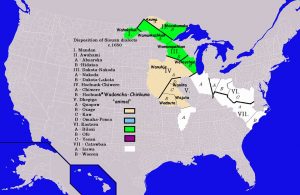
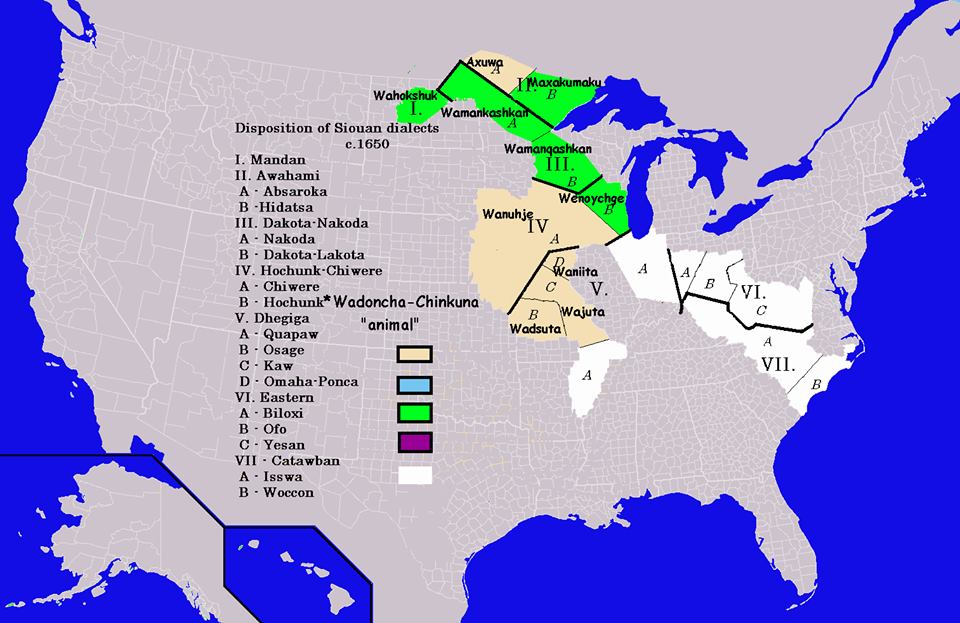
Wadoncha-chinkuna, animal.As shown on my attached map,
(1) The east is entirely missing, I couldn’t get words for ‘animal’ in any of these;
(2) Several of the shorter words (tan) pointed to something like *Wajonsha, which was curiously similar to the word I had reconstructed for “man”, *Watoncha, so I even took *Wadoncha as the balance of these two reconstructions.
(3) The longer words (green) also seem cognate, but in the longer endings, -shkan, -shuk, -kumaku, and –chge, I believe I can detect vestiges of the form *Chinkuna for the negative, which would make some sense as *Wadoncha-chinkuna, originally implying an animal that is “not human”.
Guessing what the Yesan form of this was, would probably take more data. Rankin does not include this word at all.
William Meuse
Attachments:
You must be logged in to view attached files. -
AuthorPosts
- You must be logged in to reply to this topic.
