
- This topic has 0 replies, 1 voice, and was last updated 8 years, 5 months ago by
 MarcSnelling.
-
AuthorPosts
-
April 10, 2018 at 9:24 pm #48802
Proto-Dakotan Swadesh word #49
*Wakentseecha, snake.The Mandan word /Wakiiruxka/ and another Dakota term for snake /Wamdushka/, seem to be instead from the proto-Dakotan *Wagdunshka, ‘worm’, which is tomorrow’s word. The Hidatsa word for ‘snake’ /Mapoksha/ similarly seems cognate with words for ‘insect’ or ‘ant’ in other languages, and must have replaced *Wakentseecha, which I reconstructed as the ancestor of the other words below.
WOCCON /Yawhawk/ <*Yohak <*Yoxats <*Woxats <*Wakents <*Wakentseecha
CATAWBA /Yu/ <*Yohk <*Yohak ^
YESAN /Wagen/<*Waken <*Wakenteesi <*Wakentseecha
OFO /Onkteefii/ <*Onkteesi <*Wankteesi <*Wakenteesi ^
BILOXI /Ndesii/<*Ondeesii <*Onkteesii ^
QUAPAW /Wes’a/ <*Weets’a <*Weecha <*Oweecha <*Onts’eecha <*Wantseecha <*Wakentseecha
OMAHA /Wees’a/ <*Weets’a ^
KAW /Weets’a/ ^
OSAGE /Weets’a/ ^
HOCHAK /Weken/<*Waken ^
CHIWERE /Wakan/<*Waken ^
MANDAN /Wakiiruxka/ – (< “worm”)
DAKOTA /Zuzu’eecha/ <*Onts’eecha ^
NAKODA /Snoheena/<*Sno’eecha < *Onts’eecha ^
HIDATSA /Mapoksha/- (< “insect”)
CROW /Yaxassa/ <*Yoxats ^Rankin gives differing origins for several of these. According to him, the main PS word for ‘snake’, *Wahkan, is seen in the Yesan, Hochak and Chiwere words, however if his theory is correct, Ofo /Onkteefi/ and Biloxi /Ndesii/ instead go back to the phrase *Wanhkan krese, ‘striped medicine’ (with ‘medicine’ *Wanhkan being slightly distinct from *Wahkan, snake.) He also mentions Hidatsa /Mapoksha/ along with the words for ‘insect’ and ‘ant’ as from PS *Pos, ‘vermin’. But the Dhegigan words, ie Quapaw, Omaha, Kaw and Osage, he takes back only as far as PMV *S’a, supposedly meaning ‘to hiss’.
He further claims that PS *Wahkan,’snake’ also meant ’sacred’. The words for ‘sacred’ do seem similar and may have coalesced with ‘snake’ in at least one language, viz. Hochak, but I would say they seem to go back to *Waqanda, which is seen in Yesan /Mahamni/ ‘God’, and I do not agree that it was originally related with *Wakentseecha ‘snake’.
William Meuse
Proto-Dakotan Swadesh word #50
*Wagdunshka, worm.The tan words – Quapaw, Omaha and Chiwere – are obviously related, from the abbreviated *Wagdii. The green words show the original was somewhat longer, *Wagdunshka. As noted yesterday, the terms for ‘snake’ in Mandan /Wakiiruxka/ and Dakota /Wamdushka/, are also from ‘worm’ *Wagdunshka, rather than *Wakentseecha. Hidatsa /Wiiteekii/ and Crow /Biisheechii/ could also plausibly have come from *Wagdunshka. The remaining words are more of a puzzle; Ofo /Chuluwiiya / and Catawba /Chuwii/ are probably related, and could conceivably be from <*Chuluwska <*Junska <*Dunshka, but then again they may be a different word. If the other Ofo word /Aqonhii/ and Biloxi /Tamokii/ bear any relation to these, they have morphed quite a bit away from the *Wagdunshka model. Because the eastern forms are not regular in a pattern it is more difficult to guess what the Yesan term for ‘worm’ would have been. */Chuluski/ is just a wild guess.
In Rankin’s scheme, the Proto-Siouan word for ‘worm’ was *Htawan, yet curiously, the only one of these words he derives from *Htawan is Biloxi /Tamokii/. He has the Quapaw, Hochak, Chiwere and Dakota words for ‘worm’ as being from PS *Wakri, ‘vermin’. However, he has the Osage word /Wagthushka/ as being from *Wakrushka, another PS word for ‘vermin’. Also, he says that the Hidatsa and Crow words for ‘worm’ come from PS *Wite ‘bison.’
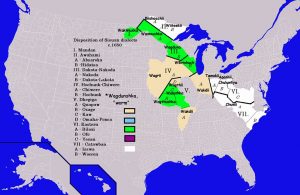
Proto-Dakotan Swadesh word #51
*Manyan, tree.The attached map shows how the original word for ‘tree’ *Manyan must have taken three different routes via *Mayan, *Manan, and *Mazhan. The first of these became Yesan /Miiyen’/, /Wiiyen/.
The Omaha /Gthabee/ seems to be taken instead from a term meaning ‘bush’ and is not cognate. Quapaw /Hii/ corresponds with a syllable /Hu/ that turns up in a number of compound words in other languages in the sense of ‘tree’, ‘leg’ or ‘bone’. I had originally included it in this reconstruction as *Mahunyan, but on closer look there is really no evidence for the *-hu- there. Simple syllables like /Hii/ and /Hu/ can also have a variety of different meanings in different languages.
There are five compound words coming upon the list that include *Manyan ‘tree’:
#52 *Manyan-pandee, forest
#53 *Manyan-kashiik, stick
#56 *Manyan-hapee, leaf
#57 *Manyan-kan, root
#58 *Manyan-araxwe, bark.Rankin’s version of *Manyan is *Wiyan, ‘tree, wood’. However, the Quapaw /Hii/ etc. are derived by him from PS *Hure, ‘tree, bone, leg, stalk, stem, trunk.’
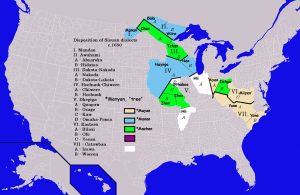
Proto-Dakotan Swadesh word #52
*Manyan-pandee, forest.This was evidently a compound of the preceding word *Manyan, ‘tree’, plus *-pandee. The *-pandee also seems to turn up in the reconstruction *Meniin-pandee ‘sea’. (*Meniin, ‘water’, + *-pandee.) Also I reconstructed ‘mountain’ as *Miinyanstek-baxee-niitsanga, where *-baxee- is probably the same element as *-pandee; on the basis of these words I assume *Pandee meant something like accumulation, collection, reserve or place.
Below are the available words for ‘forest’, showing the relationships to the words for ‘tree’:YESAN /Tahka/ – /Miiyen’/
BILOXI /Ansudii/ – /Ayan/
OMAHA /Zawndee/ – /Gthabee/
KAW /Pajee/ – /Zhan/
OSAGE /Oxtabee/ – /Zhon/
HOCHAK /Pach/ – /Nan/
CHIWERE /Paje/ – /Naynge/
MANDAN /Mananrok/ – /Manan/
DAKOTA /Tchunwantcha/ – /Tchan/
NAKODA /Chunwanja/ – /Chan/
HIDATSA: /Miida/ – /Wiira/Hidatsa /Miida/ ‘forest’ is just a variant of /Wiira/, tree. Hochak, Chiwere and Kaw are all clearly related from a common *Pajee.
The Biloxi, Omaha, Mandan, Dakota and Nakoda words for ‘forest’ all have their first element derived from *Manyan, tree. Stripped of these, the secondary elements are: /-sudii/, /-dee/, /-rok/, /-wantcha/ and /–wanja/. *Pajee, Omaha /-dee/, and Nakoda /–wanja/ all go back to the original *-pandee, Biloxi /-sudii/ is slightly more obscure and Mandan /–rok/ even more so. Yesan /Tahka/ and Osage /Oxtabee/ are apparently entirely different words; /Tahka/ in Yesan also means ‘wild,’ whether wilderness or wild animal. /Oxtabee/ in Osage seems like another manifestation of the term for ‘bush’.
In Rankin’s reconstruction, he has the Hochak, Chiwere and Kaw words as coming from PMV *Hpate, but does not attempt to take it further.
William Meuse
Attachments:
You must be logged in to view attached files. -
AuthorPosts


- You must be logged in to reply to this topic.
